



Key Points:
- Accuracy before speed: Strong muscle memory, home-row technique, and consistent 95–98% accuracy eliminate mistakes — and that’s what truly unlocks faster WPM.
- Consistent, measurable practice
Regular 15–30 minute sessions with typing tests, tools, and realistic goals drive steady improvement and prepare you for medical terminology. - Ergonomics matter: Proper posture, wrist position, and a comfortable keyboard keep you fast and precise even during long clinical shifts.
- Better typing = better job performance: Higher speed and accuracy mean quicker documentation, smoother patient flow, and stronger hiring potential as a medical scribe.
How to improve your typing speed and become a better medical scribe? First, you need to test it to define your starting point. Second, you should set your goals—make them progressive rather than big from the beginning. Then, you have to learn how to type without looking at your keyboard using the home row position. Do you want to learn more? Then keep reading!
How to Increase Typing Speed and Accuracy in 6 Easy Steps
Becoming a medical scribe requires you to have good typing abilities. After all, that’s what your job will be all about. What is a good typing speed for a medical scribe? No less than 40 words per minute. However, some employers might look for candidates who are capable of exceeding it, sometimes even reaching 70 words per minute. How do you achieve such a level? Here are some of our tips.
1. Prioritize Accuracy Over Speed—A Key Secret
This is the single most crucial step many beginners miss when learning how to improve typing speed. Trying to type fast when your muscle memory is weak leads to errors. Fixing those errors (hitting backspace) significantly slows down your effective WPM.
Actionable Tip: Slow down until you can achieve 95% to 98% accuracy consistently. Focus on hitting the correct keys every time. Once accuracy is high, speed will naturally follow because you eliminate the time spent correcting mistakes. Fast typing is not about rushing; it's about fluid, accurate movements.
2. Check Your Typing Speed
How to increase typing speed and accuracy if you don’t know what level you are on? That’s impossible. Therefore, your first step should be to test how fast you are.
Many tests are available on the internet to test both your typing speed and accuracy. Just search for “typing speed test” in Google and get down to work!
3. Set Your Goals
Knowing how many WPM you can type, it’s time to set your goals. Start small—even a 5 WPM increase will be a good goal to begin with. Scale your goals as you progress to keep improving your typing skills!
4. Learn Typing Without Looking at Your Keyboard
As a medical scribe, you might have the possibility to look at your keyboard, so this skill would seem unnecessary. However, it’s important to learn it as it can still help you a lot!
How to learn to type without looking at your keyboard and increase your typing speed and accuracy through it? You need to build muscle memory. This requires the following:
- Consistent Practice: Start slowly; your goal here is to build muscle memory, not speed.
- Utilize Typing Tools: Use dedicated typing lessons and games (e.g., TypingClub, Keybr, TypeRacer) that specifically teach finger placement and key awareness without looking.
- Focus on Letter Combinations: Consider playing typing games that require you to practice quick typing of particular, unrelated letters rather than just common words. This is vital for typing unfamiliar medical terminology.
- Learn typing from the home row position (more below).
- Type in the same position: Establish an ergonomic position in front of a computer and stick to it, as it’ll make it easier for you to locate the right keys by feel.
- Type Starting from the Home Row
So, what is the home row technique, and how can you use it to improve your typing speed?
The home row keys are A, S, D, F and J, K, L, ;.This method involves starting from the home row, which is in the middle of the keyboard. The principle here is simple—your fingers should always return to the same position so that you always hit the same keys with the same fingers. It’s similar to what tennis players do—they also return to the same position in the middle-back of the court to be able to reach any ball directed at them.
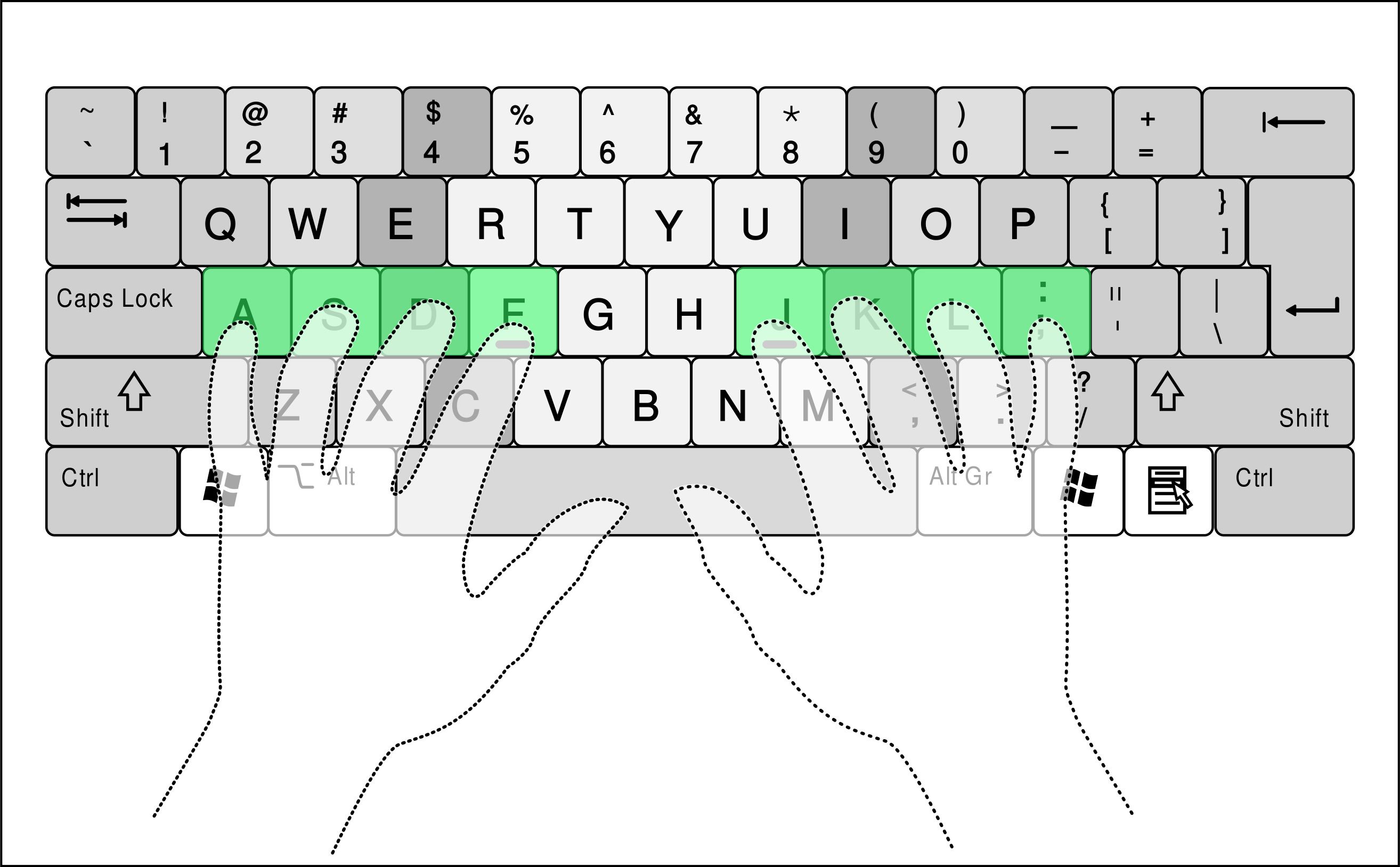
Source: Cy21, Wikimedia Commons: https://upload.wikimedia.org/wikipedia/commons/0/0d/QWERTY-home-keys-position.svg
How to practice this? Here are some example exercises:
- Column typing—strike the same keys in one column one after the other.
- Conscious practicing—while typing, put conscious effort into returning to the home row position to build muscle memory.
- Home row position exercises—don’t type; instead, practice putting your fingers in the home row position, lifting them up, and putting them in it once again.
6. Optimize Your Posture and Ergonomics
A often-overlooked step in how to increase the speed of typing on a keyboard is physical setup. Poor posture leads to fatigue and strain, which caps your potential speed and accuracy.
- Maintain Proper Posture: Sit up straight with your feet flat on the floor. Keep your back straight, with your elbows bent at a comfortable right angle.
- Screen Placement: Position your monitor at eye level and about an arm's length away. This prevents neck strain from looking down or up.
- Wrist and Hand Position: Keep your wrists straight and slightly elevated, not resting heavily on the desk or the keyboard. Many ergonomic experts recommend using the wrist rest only for breaks, not while actively typing. Your hands and fingers should be relaxed and close to the home row to minimize travel distance.
- Keyboard Comfort: Ensure your keyboard is positioned centrally to your body. Consider an ergonomic keyboard if you experience discomfort, or a mechanical keyboard for tactile feedback, which some typists find helpful for speed and accuracy.
The Takeaway: Consistency is Your Greatest Tool
Knowing how to increase your typing speed on your keyboard, you are ready to practice. Remember, you don’t have to be a pro to become a scribe, but the faster you type, the easier it will be for you to land a job and cope with the assigned tasks, as you'll spend less time transcribing and more time focusing on context.
The key to success is regular, focused practice. Even 15-30 minutes a day, concentrating on accuracy and proper technique, will yield dramatic results over a few weeks or months.
he faster you type, the easier it will be for you to land a job and cope with the assigned tasks.
And, if you’re looking for medical scribe opportunities, see our careers tab!